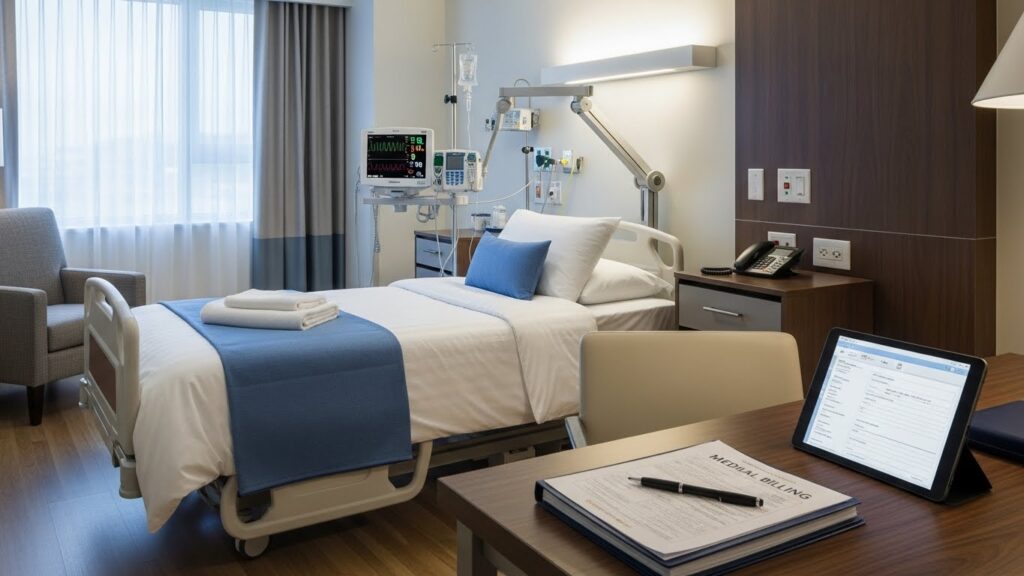
Revenue Code 0119 is used in hospital billing to report private room and ward accommodations that do not fall under standard semi-private room classifications. Misuse of this code is a common reason for denials, underpayments, and audits, especially in inpatient claims. If you don’t understand when and how to apply Revenue Code 0119 correctly, you are either leaving money on the table or inviting compliance risk.
This guide explains exactly how Revenue Code 0119 works, when it should be used, documentation requirements, payer rules, and common billing mistakes without fluff.
What Is Revenue Code 0119?
Revenue Code 0119 falls under the Room and Board revenue code category (0100–0199). Specifically, it represents:
Other room and board private accommodations not otherwise classified
It is typically used when:
- A patient occupies a private room
- The room does not qualify as standard semi-private or general ward
- The accommodation does not fit into a more specific room revenue code
This code is frequently used as a catch-all and that’s exactly why payers scrutinize it.
When Should Revenue Code 0119 Be Used?
Use Revenue Code 0119 only when no more specific room code applies.
Appropriate use cases include:
- Special private rooms requested by the patient
- Isolation rooms when not covered under standard isolation codes
- Private accommodations due to non-medical reasons (subject to payer rules)
- Facility-specific room classifications that do not align with CMS-defined categories
Do NOT use Revenue Code 0119 when:
- A standard semi-private room code is available
- ICU, CCU, nursery, or psychiatric room codes apply
- The private room was medically necessary but coded incorrectly
Hard truth: If a more specific revenue code exists, using 0119 is wrong.
Revenue Code 0119 vs Semi-Private Room Codes
One of the biggest mistakes hospitals make is confusing private room billing with semi-private room reimbursement.
Key difference:
- Semi-private rooms are typically the covered benefit
- Private rooms are often non-covered unless medically necessary
If a patient chooses a private room for comfort:
- Medicare usually reimburses at the semi-private rate
- The difference may be patient responsibility
Billing 0119 incorrectly can result in:
- Downcoding
- Partial payment
- Full denial
Medicare Rules for Revenue Code 0119
Medicare does not automatically pay extra for private rooms.
Important Medicare guidelines:
- Payment is generally limited to the semi-private room rate
- Private room charges are reimbursed only if medically necessary
- Medical necessity must be clearly documented
Examples of medical necessity:
- Isolation due to infection
- Immunocompromised patient
- Behavioral or safety concerns
Without documentation, expect reduced reimbursement.
Commercial Payer Considerations
Commercial payers vary widely.
Some commercial plans:
- Pay full private room charges
- Require prior authorization
- Reimburse at contracted room rates
- Shift extra charges to patient responsibility
Never assume payer behavior.
Always verify:
- Contract language
- Benefit coverage
- Room and board limitations
Documentation Requirements for Revenue Code 0119
Documentation is the difference between payment and denial.
Required documentation should include:
- Reason for private room assignment
- Medical necessity (if applicable)
- Physician or nursing notes
- Admission and bed assignment records
If documentation does not justify private accommodation:
- Expect payer adjustments
- Expect audit risk
Billing without documentation is reckless.
How Revenue Code 0119 Appears on a UB-04 Claim
On the UB-04 claim form:
- Revenue Code: 0119
- Units: Number of days in private room
- Charges: Daily room charge × number of days
Errors to avoid:
- Mismatch between LOS and units
- Charging private room rates without payer approval
- Billing 0119 for partial-day stays incorrectly
Common Mistakes with Revenue Code 0119
Here’s where hospitals screw this up:
- Using 0119 as a default room code
- Billing private room charges without medical necessity
- Ignoring payer-specific room coverage rules
- Missing documentation to support private placement
- Charging patient balances incorrectly
Each of these leads to lost revenue or compliance exposure.
Revenue Code 0119 and Patient Responsibility
Private rooms often create patient balance disputes.
Best practice:
- Inform patients upfront if private room charges are non-covered
- Obtain written acknowledgment
- Clearly separate payer vs patient responsibility on statements
Surprise billing destroys trust and delays collections.
Audit and Compliance Risks
Because Revenue Code 0119 is:
- Non-specific
- Frequently overused
- Associated with higher charges
…it is a prime audit target.
Auditors look for:
- Overbilling patterns
- Lack of medical necessity
- Inconsistent room coding
If your usage rate of 0119 is high, expect scrutiny.
Best Practices for Using Revenue Code 0119
To stay compliant and maximize reimbursement:
- Use specific room codes whenever possible
- Verify payer policies before billing
- Document medical necessity clearly
- Educate registration and nursing teams
- Audit room revenue codes regularly
Discipline beats damage control.
Role of RCM Teams in Private Room Billing
Private room billing is not just a coding issue.
It involves:
- Admissions
- Nursing documentation
- Coding accuracy
- Contract management
- Patient communication
Disconnected teams = revenue leakage.
How NAHL Supports Revenue Code 0119 Compliance
NAHL helps healthcare providers correctly apply Revenue Code 0119 by aligning clinical documentation, coding accuracy, and payer rules.
Our support includes:
- Revenue code audits
- Room and board billing reviews
- Denial analysis and prevention
- Compliance-focused RCM workflows
We don’t guess. We bill correctly.
Final Takeaway
Revenue Code 0119 is not a shortcut.
It is a high-risk, high-scrutiny code that must be used carefully.
Use it only when appropriate, document aggressively, and align billing with payer rules or expect denials and audits.
Need help fixing private room billing issues?
Partner with NAHL to ensure Revenue Code 0119 is applied correctly, compliantly, and profitably. Contact NAHL today to stop revenue loss before it happens.